
0 – 1 m Soil
Topsoil
Soil in Kullu is usually half a metre to a metre deep. The rig's foot clamp sits on it; the first metre goes quickly.
A borewell is a narrow hole, 4 to 8 inches across, drilled deep into the ground to reach water held in loose river gravels or in the cracks of rock. Pipe called casing lines the loose upper ground so it cannot fall in, and a submersible pump lifts the water out. Unlike a dug well — wide, shallow and fed by the top layer of water — a borewell is narrow, goes deep and takes almost no land.
How it's done
This is how a borewell goes in on a Kullu site, from the first visit to water at the tap.
Where the rig can stand, how it gets there, what the water is for, and what nearby wells and springs say about the ground.
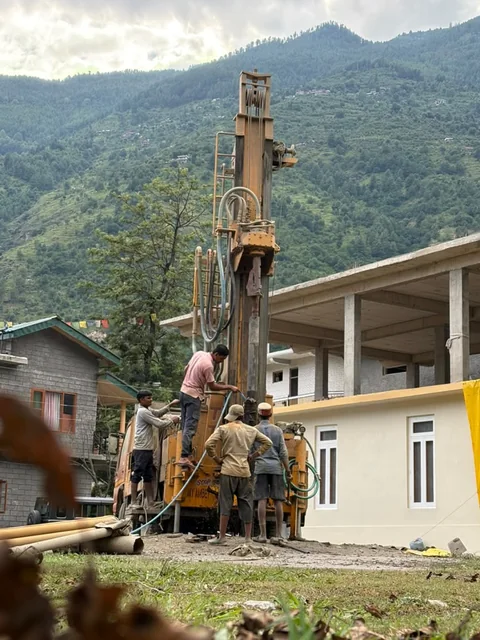
The truck — or the portable rig, where there's no road — is levelled on its jacks over the spot and the mast raised upright.
The valley's top layers are loose boulders, cobbles and gravel. Casing pipe follows the hole down so it cannot cave in.
In rock, the DTH hammer at the bottom of the rods breaks it with the bit; air from the compressor drives the hammer and blows the chips up and out.
When the bit reaches a water-bearing layer, water comes up with the air and the cuttings. The driller watches how much, and how it holds.
The bore is flushed with air until the water runs clear, so sand and fines don't wear out the pump.
A submersible pump is chosen for the bore's depth, water level and yield, and lowered on its pipe and cable.
The pits are filled and the top capped. A dry bore is filled to the top, never left open.
Under a Kullu site
No two sites are the same. This is the kind of ground the Kullu valley is made of — from the Central Ground Water Board's report on the district — and what happens in each layer.
0 – 1 m Soil
Soil in Kullu is usually half a metre to a metre deep. The rig's foot clamp sits on it; the first metre goes quickly.
Layers and depths are an illustration based on CGWB, Ground Water Information Booklet, Kullu District (2013) — not a survey of your site.
There is no fixed depth. The Central Ground Water Board's nine test wells in Kullu district went 18 to 101 metres, and the valley's standing water level is 1.6 to 31.5 metres below ground. Your bore goes as deep as your site's water-bearing layer — our truck rig can drill to 200–250 m, the portable rig to 100 m. Elsewhere it differs again: in Mandi's Balh valley CGWB records tube wells 38 to 141 m deep; in Lahaul the state's bores are 35 to 70 m.
Bore sizes
A bore's diameter is chosen for what the well must supply — and for the pump and casing that will go into it.
Drawn to scale against each other
5″ bore
≈ 127 mm across
A practical size for residential, commercial and agricultural use.
The final size is chosen for your site's conditions, the water you need and the pump and casing system.
Ask which size fitsA wider bore takes a bigger pump and more water per hour, if the ground can give it — it does not create more water. A 4″ or 5″ bore suits most homes; hotels, institutions and big farms usually need 6″ to 8″. The final size depends on your site and how much water you need.
No price list — here's why
Two borewells a kilometre apart can cost very different amounts. These are what decide it:
How far down the water-bearing layer sits at your site.
4″ to 8″ — a wider hole is more rock to cut and bigger casing.
Deep boulder and gravel layers need more casing pipe to hold the hole open.
Hard rock is slower to cut and wears the bit and hammer.
Whether the truck can reach, or the portable rig is carried in.
How far the site is from Bhunter.
Sized to the finished bore's depth and water.
In Kullu, CGWB's 2012 samples from springs and wells were within the BIS limits for drinking water; only hot-spring water failed (fluoride up to 8.2 mg/l). Still, have a sample from your own bore tested at a water-testing laboratory before you drink it.
Yes, in some form. Since 19 November 2019 the whole state is notified under the HP Ground Water Act. Households, farms, rural drinking-water schemes and micro or small enterprises drawing under 10 m³ a day register their well with the Ground Water Authority, free; hotels and other users apply for a permit first. Every rig must be registered too. The Himachal rules page has the detail and the sources.
It happens — nobody can see water before drilling. A failed or abandoned bore must never be left open: the Supreme Court's 2010 order says it is filled with clay, sand, pebbles or cuttings from the bottom up to ground level. That is also why no honest driller promises water: CGWB itself says most of Kullu district's hard rock is unexplored and its yield unknown.
In the Kullu valley, CGWB notes that open dug wells tapping the top water layer are the main domestic and irrigation source, and springs feed most hill villages. A borewell is the answer where those run short or dry in winter, where there is no room for a dug well, or where the property needs more water than a spring gives.
A rig stands over the spot on jacks. Through soil and boulders it drills while casing follows the hole down; in rock, a DTH hammer driven by compressed air breaks the rock and the same air blows the chips and water up and out. When the water-bearing layer is reached, the bore is flushed clean and a pump is fitted.
It depends on how deep the bore goes, its diameter, how much casing the loose ground needs, how hard the rock is, whether the truck or the portable rig is needed, how far the site is from Bhunter, and the pump and pipe. We quote after seeing the site.
No. No drilling company can honestly guarantee groundwater at every site — it depends on what is under the ground. We tell you what we see before we start.
Yes. Along with our truck-mounted rig we have a portable rig for hill sites with narrow or no road access — it drills up to 100 metres.
Yes. The pump is chosen for the finished bore's depth, water level and yield.
Central Ground Water Board, Ground Water Information Booklet, Kullu District (March 2013) — cgwb.gov.in/sites/default/files/2022-10/kullu.pdf Central Ground Water Board, Ground Water Information Booklet, Mandi District (September 2013) — cgwb.gov.in/sites/default/files/2022-10/mandi.pdf Central Ground Water Board, Aquifer Mapping and Management Plan of Lahul Valley, Lahaul & Spiti District (2021) — cgwb.gov.in › NAQUIM reports › Himachal Pradesh HP Ground Water (Regulation and Control of Development and Management) Act, 2005, as amended in 2022; Supreme Court of India, order of 11 February 2010 on open borewells This guide explains how borewells are generally drilled; it is not a survey of your site. Checked 8 October 2026.
Site enquiry
Where the site is, what the water is for, and whether the rig truck can reach it. We call you back — or send it on WhatsApp.