

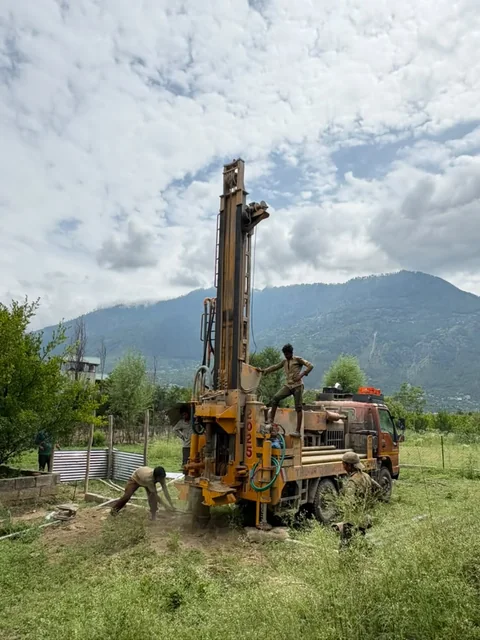
What is the ground like for borewells in Mandi?
Mandi district is mostly rock. CGWB's 2013 booklet puts about 65% of it in old crystalline and metamorphic hard rock, where yields are low (under 3 litres a second) and springs and hand pumps are the usual sources; 32% in Siwalik and Subathu rocks, low to moderate (2–10 litres a second); and only about 3% in valley alluvium — the Balh valley, part of Sarkaghat and small pockets — where yields are high (10–30 litres a second).
CGWB, Mandi District booklet (2013)
Mandi in numbers
- Balh valley tube wells
- 38 – 141 mdeep
- Their yield
- 15 – 999 l/min
- Water level in them
- free-flow – 19.4 mbelow ground
- Dug wells, Balh
- 8 – 26 mwater 0.9–9.9 m down before the monsoon
- State hand-pump bores
- 30 – 60 m0.5–2 l/s, in hill rock
- CGWB test wells
- 19in the district
Are there free-flowing borewells in Mandi?
Yes. CGWB records artesian, free-flowing conditions in low-lying ground along the Suketi khad in the south-west of the Balh valley — water rises out of the well on its own. In the rest of the district, a bore needs a pump.
Which rig suits Mandi's ground?
CGWB's own guide for the district: in the valley's soft deposits, tube wells of 100–120 m by percussion or rotary rigs; in hard rock, bore wells of 100–150 m by DTH with ODEX — the air-hammer method for rock, with casing driven through the boulders. It also notes the Balh valley's development stage was 15% — 'safe', with room for more wells.
Borewells in Mandi — questions
How deep are borewells in Mandi district?
In the Balh valley, CGWB records tube wells 38 to 141 metres deep. In the hard rock that covers about two-thirds of the district, state hand-pump bores are 30 to 60 metres. The right depth depends on the site.
How much water does a borewell give in Mandi?
It depends on the ground. CGWB rates the valley alluvium high (10–30 litres a second), the Siwalik rocks low to moderate (2–10) and the hard rock low (under 3). Balh valley tube wells gave 15 to 999 litres a minute.
Do you drill borewells in Mandi district?
Yes, by project. We are at Bhunter, just up the Beas from Aut and the Mandi district line. Call or WhatsApp with the location.
Sources
Central Ground Water Board, Ground Water Information Booklet, Mandi District (September 2013) — cgwb.gov.in/sites/default/files/2022-10/mandi.pdf Checked 8 October 2026.
Site enquiry
A site in Mandi district?
Where the site is, what the water is for, and whether the rig truck can reach it. We call you back — or send it on WhatsApp.
- We talkAbout the site, the water you need and the bore size.
- We see the siteAccess for the rig, the ground, nearby borewells.
- We drillDrilling, casing where needed, cleaning — and a pump if you want one.
- Call
- 98058-13194
- Based in
- Bhunter, Kullu, Himachal Pradesh