

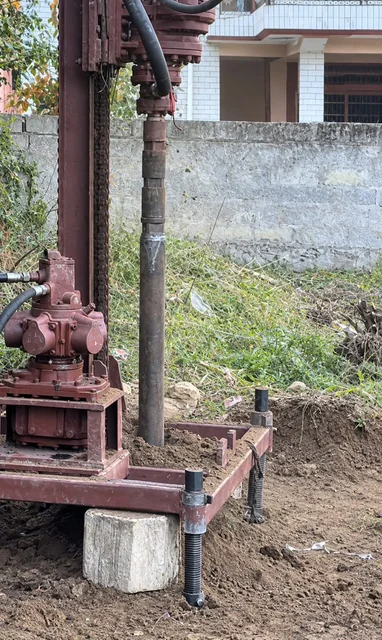
Can you drill a borewell in Lahaul?
Yes, in the right places. The state has drilled bores of 35 to 70 metres with hand pumps in the valley, and CGWB names the gentle ground at Jispa and Udaipur as worth developing. The work is done in the months the valley is open. Springs and snow-fed kuhls remain the valley's main water; a bore is for where they fall short.
CGWB, Lahul Valley aquifer report (2021)
Lahaul in numbers
- State valley bores
- 35 – 70 mwith hand pumps
- Water level in them
- 7.8 – 59.4 mKoksar to Maragaon
- Each bore gives
- 12 – 20 l/min
- Valley-fill thickness
- up to 100 m0–3 km wide, broken
- Hill rock bores
- 1 – 5 l/sshale, schist, dolomite
- Rainfall
- 125 – 381 mma year — snow does the rest
Where is groundwater in Lahaul?
In the valley fills — river and glacial gravels, pebbles and boulders up to about 100 metres thick, in strips along the Chandra, Bhaga and Chandra Bhaga. CGWB names two places worth developing: the gentle scree slope at Jispa on the Bhaga, and the alluvial flat at Udaipur where the Miyar Nala meets the Chandra Bhaga.
When can a borewell be drilled in Lahaul?
In the open months. CGWB's report notes heavy snow from November to April; plan a bore for late spring to autumn, and ask us early so the rig can be fitted in.
Borewells in Lahaul — questions
Can a borewell be drilled in Lahaul?
Yes, in the right places. The state has drilled bores of 35 to 70 metres with hand pumps in the valley, and CGWB names the gentle ground at Jispa and Udaipur as worth developing. The work is done in the months the valley is open.
Why does Lahaul have few borewells?
Springs and snow-fed kuhls have always supplied it, and heavy rigs struggle to get there — CGWB itself never drilled test wells in the district for that reason. A portable rig changes the access problem.
How deep is the water in Lahaul?
In the state's valley bores, CGWB records the water level from 7.8 metres below ground at Koksar to 59.4 metres at Maragaon, with 12 to 20 litres a minute from each bore.
Sources
Central Ground Water Board, Aquifer Mapping and Management Plan of Lahul Valley, Lahaul & Spiti District (2021) — cgwb.gov.in › NAQUIM reports › Himachal Pradesh Checked 8 October 2026.
Site enquiry
A site in Lahaul?
Where the site is, what the water is for, and whether the rig truck can reach it. We call you back — or send it on WhatsApp.
- We talkAbout the site, the water you need and the bore size.
- We see the siteAccess for the rig, the ground, nearby borewells.
- We drillDrilling, casing where needed, cleaning — and a pump if you want one.
- Call
- 98058-13194
- Based in
- Bhunter, Kullu, Himachal Pradesh